How to choose a veneer shade
We explain why the same shade can look different on different patients and why the final choice is best made with your dentist.
Take a short quiz to get a suggested shade and a consultation promo code.
Select one answer to continue.
Your suggested shade
Mention the promo code when booking and bring your quiz result to your consultation.
Your quiz result is a starting point for discussion. Your dentist will check the shade against a guide, in your mouth, in daylight and artificial light, and assess your existing tooth colour and the parameters of your future veneers.
Expert videos
Four short vertical videos help you understand the difference between BL1, BL2, BL3, BL4 and B1: when bright on-screen whiteness works, and when a softer, more natural look is preferable.
We explain why the same shade can look different on different patients and why the final choice is best made with your dentist.
We explain when the camera calls for brighter whiteness and when a more natural shade looks more refined and harmonious.
We show why a beautiful shade depends on more than whiteness: it also depends on how your smile works with your face, lips and lighting.
We explain why the final shade is chosen using a shade guide, real examples, lighting and veneer parameters, rather than from memory.
Do not start by asking “which is the whitest?”
Veneer colour is perceived as part of the person. Skin tone, lips, the whites of the eyes, how much of the smile is visible, the colour of the teeth beneath the restorations, ceramic thickness, translucency, cement shade and lighting all affect it. That is why the same BL3 can look different on two patients.
Modern aesthetics increasingly move away from ostentatious, dazzling whiteness towards a lifelike smile: light and well cared for, with translucency, texture and shape that work with the face.
Fair skin and delicate features can be overwhelmed by a very bright shade. High-contrast colouring often carries whiter shades better.
A wide smile makes the shade more noticeable. In a closed smile, the teeth are more often shaded by the lips and look different.
The colour of the tooth beneath a veneer affects the final result, especially with thin, translucent restorations.
Opacity, ceramic thickness, translucency and cement shade can make the same shade code look different.
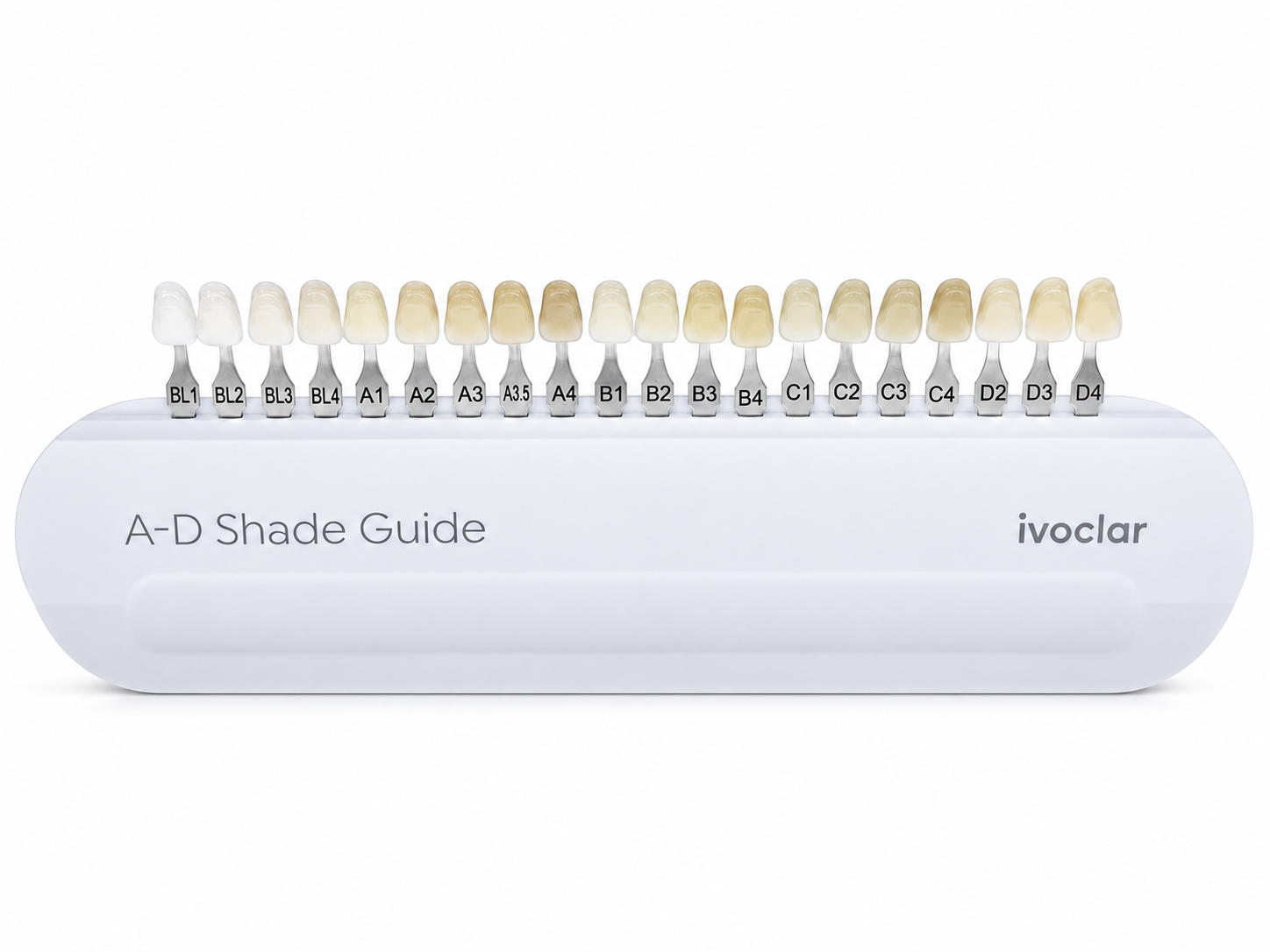
VITA A-D Shade Guide
The guide shows the pattern: BL1–BL4 are bleach shades, while B1 is a light, natural shade on the classic scale.
Interactive comparison
Compare how the shades feel: maximum whiteness, an on-screen effect, versatile aesthetics or subtle naturalness.
A white, noticeable smile that does not demand all the attention.
Visual comparison
Greater brightness makes the effect more noticeable. Greater naturalness makes the shade look subtler in everyday life.
The whitest, brightest, most theatrical smile.
Main risk: it can look cold and artificial without precise shape and translucency.
Striking whiteness, softer than the extreme BL1.
Main risk: opaque ceramics can give it an overly porcelain-like look.
A white smile that often has broader appeal than BL1–BL2.
Main risk: it is still a bleach aesthetic and needs lifelike anatomy.
A subtle bleach shade with a more delicate appearance.
Main risk: it may seem insufficiently bright if pronounced whiteness is the goal.
The “my own teeth, beautifully cared for” effect.
Main risk: it may seem too subtle if you expected a bleach effect.
Visual references
Compare how different shades look in a smile. At your consultation, your dentist will show clinical examples and explain how light, shape, ceramic translucency and your existing tooth colour affect the shade.
A starting point for a bright, noticeable, stage-ready result.
A starting point for a striking smile that looks good in photos and videos.
A starting point for a white smile without maximum theatricality.
A starting point for subtle bleach aesthetics when delicacy matters.
A starting point for the “my own teeth, only better” effect.
Why a consultation matters more than choosing on screen
The final colour depends on more than the BL1, BL2, BL3, BL4 or B1 label. Your dentist considers the material, thickness, translucency, existing tooth colour, cement, smile shape and how the shade behaves in daylight, clinic lighting and studio light.
Make the final choice with your dentist
At your consultation, discuss the effect you want, compare shades, assess your existing tooth colour and find your balance between whiteness and naturalness.
Mention the promo code “My ideal shade” for 50% off a shade-selection consultation.
FAQ
Detailed answers for anyone choosing between BL1, BL2, BL3, BL4 and B1 who wants a harmonious result.
The whitest shade discussed here is BL1, or Bleach 1. It is an extremely bright bleach shade. It does not suit everyone, because it requires very precise shape, translucency and overall smile aesthetics.
No. BL1 is Bleach 1, one of the lightest bleach shades. B1 is a light, natural shade on the classic scale. B1 is often chosen for the “my own teeth, only perfect” effect, without an obvious bleach result.
B1 and BL4 most often give the most natural effect. BL3 is visibly whiter and more striking, but can also look harmonious with the right shape, texture and translucency. The choice depends on your face and expectations.
Very white shades can look cooler in shadow: beside the oral tissues and lips, and without bright light, they may appear bluish-grey. Ultra-white shades should therefore be assessed in real lighting, as well as in photographs.
Bleach shades at the BL1–BL4 level generally relate to aesthetic restorations rather than regular whitening results. Whitening lightens natural teeth, but cannot always make enamel reach these extremely light shades.
BL3 and BL4 are common starting points. BL3 suits a visibly white smile. BL4 suits softer whiteness and those concerned about veneers looking too bright.
B1 or BL4 are usually worth discussing. However, shade is only one aspect of naturalness. Tooth shape, translucent incisal edges, surface texture, symmetry and harmony with your face matter just as much.
BL1 and BL2 can work particularly well on camera: studio lighting, the lens and overall styling often reduce perceived brightness. Even then, the shade needs to be tried alongside your face, lips, skin and intended image. BL2 sometimes offers a better balance than BL1: the smile remains very white but looks slightly softer.
BL3 often suits people wanting a white, fresh, noticeably attractive smile without a strong theatrical effect. It is a useful option to discuss when you want brightness without extremes.
BL4 suits patients who want a light smile but are concerned about overly white veneers. It is the subtlest bleach shade and often looks softer and warmer.
B1 suits people who want the most natural effect: teeth that look like their own, beautifully cared for, light and attractive. It is often considered for discreet, elegant aesthetics.
BL1 may suit patients who deliberately want the whitest, brightest, most noticeable smile, for example for a public image, frequent photos and videos or a pronounced luxury effect. It is important to understand that it is not the discreet option.
BL2 is very white and striking, yet softer than BL1. It is worth discussing if you want bright whiteness without maximum theatricality. Like BL1, it requires careful shape and translucency.
Photos depend on lighting, the camera, retouching, lip and skin colour, screen settings and angle. The same shade may look different in real life from Instagram or a studio image. Photos are useful references for a desired look, but do not provide an exact shade choice.
The final colour combines many factors: existing tooth shade, veneer thickness, ceramic translucency and opacity, cement colour, tooth shape, lips, skin and lighting. The shade code is only a starting point.
Both matter. Even an ideal shade can look unnatural if the shape is overly uniform, flat or unsuitable for the face. Conversely, well-designed shape, surface texture and translucency can make even a bright bleach shade look more refined.
Your dentist considers not just your wish for whiter teeth but how the colour will work with your skin, lips, the whites of your eyes, facial expressions and lighting. A softer shade can sometimes look more refined and youthful than maximum whiteness.
You can get a preliminary idea from your style, facial contrast, comfort with brightness, camera work and expectations. However, BL1 should be assessed at a consultation, under different lighting and alongside your face, rather than from pictures alone.
Save your suggested shade and mention two shades to your dentist: your main result and a neighbouring shade for comparison. If your result is BL3, for example, compare it with BL2 and BL4. This makes the consultation more focused and the choice easier.