A regular tooth
9 000 ₽
Extraction of one tooth
An erupted or damaged tooth or root, when the procedure is not classed as a complex wisdom tooth extraction.
View oral surgery prices ↗Tooth extraction prices at White Art
The price depends on tooth position, access and the extent of surgery. After an examination and imaging, we agree on a treatment and financial plan so there are no unexpected surcharges on extraction day.
A regular tooth
An erupted or damaged tooth or root, when the procedure is not classed as a complex wisdom tooth extraction.
View oral surgery prices ↗An erupted wisdom tooth
The price applies to a wisdom tooth that has erupted fully or sufficiently and does not require complex access through bone.
More about the service ↗An impacted or misaligned tooth
The surgeon determines the level after reviewing the scan. It depends on depth, tooth angulation, root shape, the extent of access and proximity to important anatomical structures.
More about the service ↗A wisdom tooth near the mandibular nerve
The price list entry is for one tooth. This approach is considered when direct extraction carries higher risk and it is preferable to first move the tooth into a safer position.
More about the method ↗All prices are per tooth. White Art prices are listed as all-inclusive. If diagnostics show that other procedures are needed, these will be listed separately in your financial plan in advance. Price information is not a public offer.
Routine and complex tooth extraction
One tooth can be gently removed at once, another is better divided into sections, and a third should first be moved away from the nerve. We decide after diagnostics.
We preserve the socket walls and soft tissues. If inflammation is present nearby, we clean the surgical area and consider future tooth restoration.
We plan access using CBCT. When needed, we divide the tooth and remove fragments along separate paths to avoid unnecessary stress on the bone.
We compare direct extraction, coronectomy and preliminary traction, then choose the option that best suits your anatomy.
Not every wisdom tooth needs extraction. A healthy tooth that is accessible for cleaning and does not harm neighbouring tissues can be monitored.
Gentle surgery
The surgeon’s task continues after the tooth is removed. It is important to preserve healthy bone, the gum contour and conditions for healing or future implant placement.
Clinical example
The result shown is from a specific clinical case.
Patient story · Thailand → Moscow
The roots passed close to the mandibular canal. We reviewed the CBCT in advance, proposed staged treatment and explained its duration before the trip.
The patient tells the storyThe approach and outcome are individual
Author of a patented method
The method is intended for selected cases in which impacted tooth roots lie very close to the mandibular canal. The tooth is gradually moved in a calculated direction, its position is monitored on scans, and extraction takes place once the distance from the risk area increases.
The surgeon decides on traction after examination and CBCT. If the tooth can be safely extracted immediately, an additional stage is not needed.
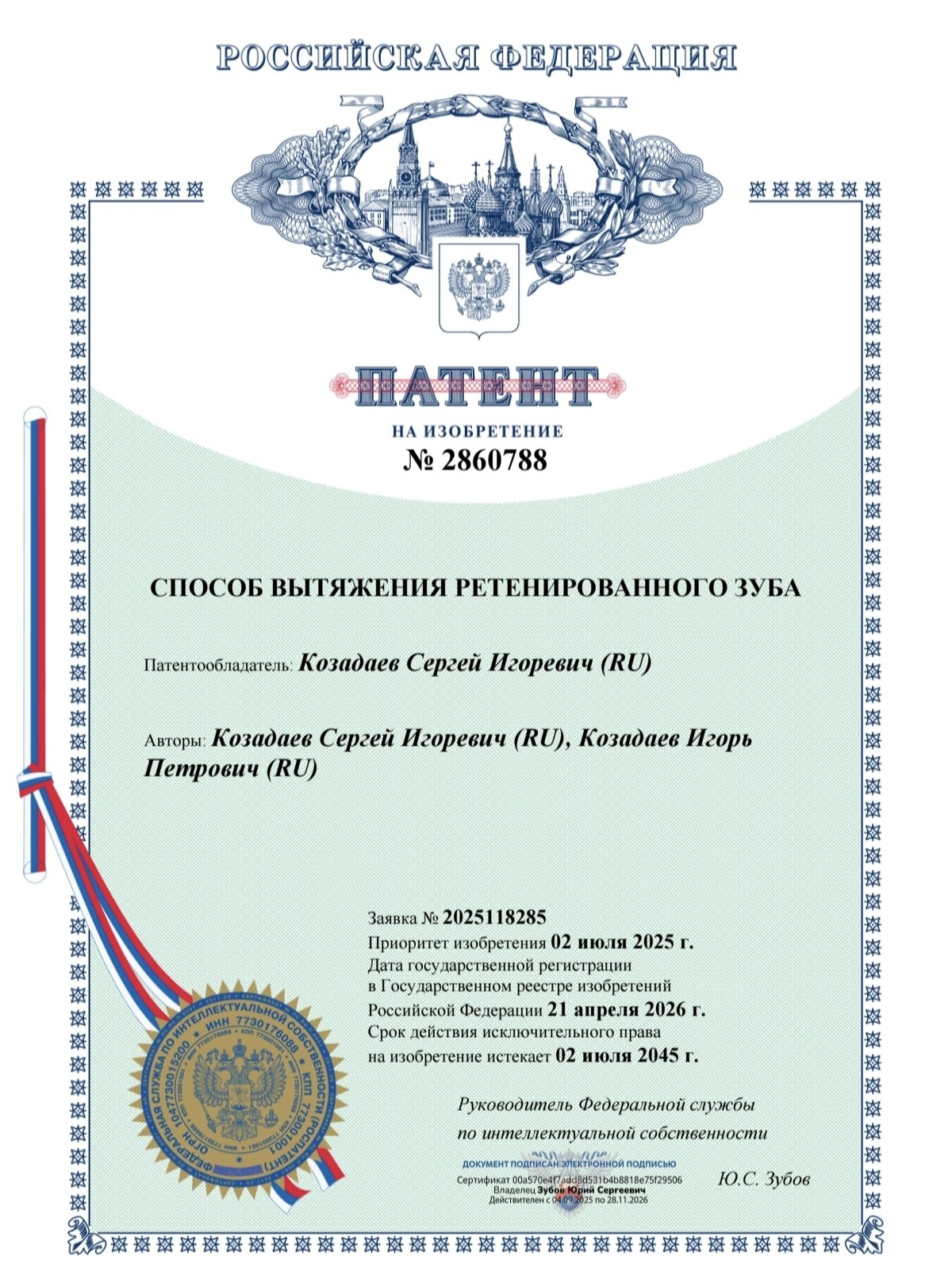
Russian patent No. 2860788
The patent describes a method with a pre-calculated direction of traction. It is not needed for every patient and does not replace other surgical options. Indications are determined by examination and CBCT.
We examine the roots and mandibular canal on CBCT.
We set the traction direction and monitor tooth movement.
We reassess risk and perform the final surgical stage.
The inventors are S. I. Kozadaev and I. P. Kozadaev. Patent RU 2860788 C1 covers a specific method of impacted tooth traction with an individualised periosteal fixation device and a predetermined traction vector.
For patients from other cities and countries
If you live far away, start with a CBCT scan and a brief treatment history. We will assess possible options in advance, and a coordinator will help clarify the number of stages, timing and estimated financial plan.
Discuss my case ↗Tell us your concerns, what other dentists suggested and when you can visit.
We discuss the possible approach, number of stages and visit arrangements.
After an in-person examination, we confirm treatment, the final cost and schedule.
Routine extraction can often be completed in one visit. Preliminary traction requires several stages and check-ups. This will be clear before travel arrangements are agreed.
How tooth extraction works
The extent of surgery may vary, but the sequence remains clear. We explain what the scan shows, how the area will be anaesthetised and what to expect afterwards.
We study the scan and discuss indications, treatment options, anaesthesia, costs and recovery.
There should be no sharp pain. Access and tooth sectioning are chosen for the anatomy.
You receive personalised prescriptions, an information sheet and clinic contact details for questions during healing.
After tooth extraction
Pain, swelling and healing time depend on surgical complexity. The following is general guidance; your surgeon’s individual recommendations take priority.
Do not touch the socket with your tongue, toothbrush or hands, and do not rinse vigorously. The clot protects the extraction site and helps it heal.
After complex extraction, these may increase over the first 2–3 days, then should decrease. Take only prescribed medication.
If pain or swelling increases, bleeding does not stop, a high temperature persists, pus appears, or swallowing or breathing becomes difficult.
Food and care. Eating is usually possible once numbness has worn off, following your dentist’s instructions. Choose soft food that is not hot. Do not rinse vigorously in the first 24 hours; use mouth baths and antiseptics only as prescribed.
Medication, stitches and restrictions. Antibiotics and pain relief are taken on an individual schedule. If stitches are placed, the surgeon will set a check-up or removal date. Smoking, alcohol, sauna use and intensive exercise may interfere with healing.
Wisdom tooth extraction · frequently asked questions
No. A healthy wisdom tooth that does not affect neighbouring teeth and can be cleaned can be monitored. Extraction is recommended when indicated, including inflammation, damage, a cyst or risk to a neighbouring tooth.
The surgeon reviews CBCT and plans access. When needed, the tooth is divided and removed in fragments along separate paths. This helps preserve more surrounding bone.
Clarify the anatomy with CBCT and compare the options: direct extraction, coronectomy or preliminary traction. Proximity to the canal alone does not determine the surgical approach.
Extraction is performed under local anaesthesia, so there should be no sharp pain. You may feel pressure, touch and vibration. Afterwards, the dentist explains how to manage soreness and swelling.
At White Art, extraction of an erupted wisdom tooth costs ₽14,000. An impacted or misaligned tooth costs ₽17,000, ₽22,000 or ₽26,000 depending on complexity. Extraction with orthodontic traction is listed at ₽50,000 per tooth.
An erupted tooth with simple anatomy is usually removed faster than an impacted wisdom tooth. The surgeon will estimate the time after reviewing the scan. If preliminary traction is needed, treatment has several stages.
After complex extraction, soreness and swelling are often most noticeable in the first 2–3 days and should then decrease. Soft tissues heal over several weeks; bone takes longer to remodel. Contact the clinic if your condition worsens.
Eating is usually possible once the anaesthetic wears off. Choose soft food that is not hot and chew on the other side. During the first 24 hours, do not rinse vigorously or disturb the blood clot.
Sometimes. Immediate implant placement is possible if the socket condition, bone volume and ability to secure the implant allow it. In other cases, the dentist will suggest a delayed protocol.
Tooth extraction at White Art
If you already have a CBCT, share it with the coordinator. If you do not have a scan, leave a request: we will advise where to start with diagnostics and help book a consultation.